
Starting a Savage Residents Directory Search
Savage has no single municipal roll of all households. The most reliable starting point depends on whether the known fact is a present address, a personal name, a historic year, or a court or estate clue. Scott County keeps the parcel, tax, land-record, election, jail, and data-practice routes; state agencies keep court, vital, credential, and filing systems; the library and archives hold the older local layer. A property name or tax mailing line is a lead, while a voter match, directory entry, or deed is a dated record with a different purpose.
For a current property question, work from address to PID before opening the land index. For a person question, collect a middle initial, approximate age, street or organization, then seek a second independent record. For an older household, begin with a year and pull a directory or newspaper before assuming a current portal will know the answer.
- Choose one documented clue: full name, address, year, parcel, or case number.
- Use the Scott County property or GIS route to identify a parcel and its nine-digit PID.
- Check the appropriate official index, such as land records, MCRO, voter status, or a vital index.
- Compare a second dated source before treating two similar names as the same person.
- Use the custodian, library, archive, or a targeted Minnesota Government Data Practices Act request when the online trail ends.
Savage Residents Directory Custodians
Savage lies in Scott County, whose county seat is Shakopee. That split matters: a Savage street can lead to a Scott County office, not a city counter. The property portal and Land Records Department provide the core parcel and instrument trail, while Scott County Elections and the Minnesota Secretary of State manage election records. The city handles subject-specific permits, police data, and clerk requests. For a broader address chain, use the Savage street directory guide after identifying the record type.
Scott County Land Records
200 Fourth Avenue W
Shakopee, MN 55379
952-496-8150
Scott County Property Information
County parcel and tax route
Scott County, Minnesota
Property search online
Savage Parcel IDs Join the County Record Trail
The nine-digit Scott County PID is the most useful bridge for an address-based Savage residents directory search. The county property instructions direct users to search by either house number plus the first few street characters or by PID, not by both together. A property result can show the situs address, legal description, building and valuation details, tax data, sale rows, and recorded-document links. The portal defaults to the current tax year, is updated weekly, and is explicitly reference-only.
| Portal control | How Savage searchers use it | What the next step can be |
|---|---|---|
| House number and street text | Find a situs-address result in the county property portal | Copy the PID and legal description |
| Nine-digit PID | Open the parcel, tax, sale, and document information | Use PID in the Land Records index |
| Tax year | Check the default current-year context before reading a result | Keep the date with the result in notes |
| ScottGIS3 taxpayer-name search | Use a taxpayer clue when the property portal does not document name search | Confirm parcel geometry and PID on the map |
See the county’s property-search instructions before entering a Savage address. The screen below illustrates the official address and PID route; it does not prove current occupancy.
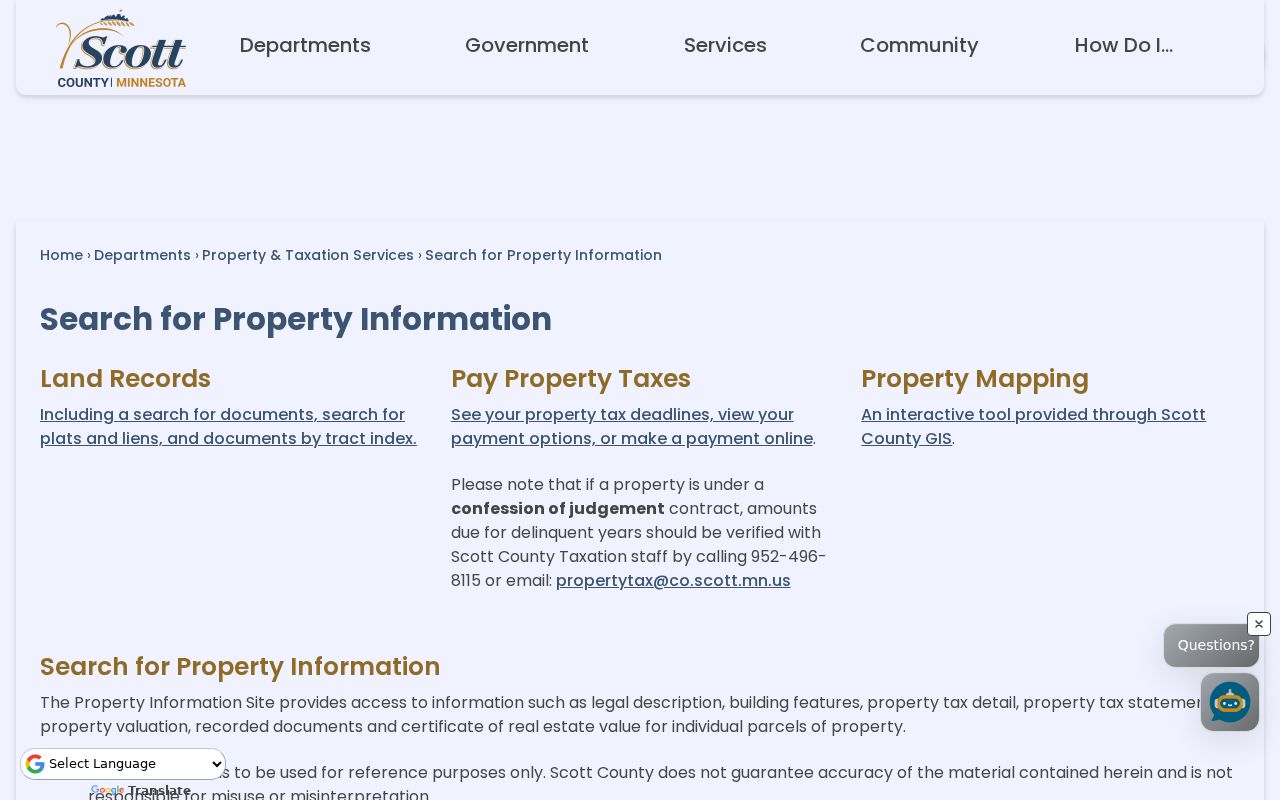
Use a PID and legal description to compare records, because a street label alone can change or be formatted differently across systems.
Read Savage Tax Mailing Lines With Care
A tax record distinguishes a parcel’s situs from its mailing address. Situs is the physical parcel location; a mailing line is where tax correspondence is sent and may be outside Savage. Homestead or exemption data is a tax classification. It can support a cautious, dated owner-occupancy inference when paired with other records, but it does not name everyone who lives there or prove who is present today.
Three terms that keep a search on track
Parcel: the county-defined property unit identified by a PID. Situs: the physical address assigned to that parcel. Index: a finding tool that points to a record, not necessarily the complete record image.
The public parcel card can also show a sale row with grantor, grantee, document number, dates, price, instrument type, and ECRV information. Those fields describe a transaction. A title, mailing address, or sale row should not be turned into a claim about an entire household.
ScottGIS3 Maps Place Savage Records on a Parcel
ScottGIS3 supplies the map context the property card lacks. Its search options include address, taxpayer name, PID, intersection, section, and coordinates. After finding the target, turn on parcel outlines and aerial imagery, then inspect the parcel, tax, flood, soil, wetland, district, or land-record layers that fit the question. The county describes roughly 120 layers, and the result should be saved with its date because map layers can change.
A map search is especially useful when an old directory or newspaper mentions a subdivision, a river or rail corridor, or a street format that is hard to match. Click the target parcel first, then use the PID rather than guessing from a shared drive, mailbox, or nearby label. The SG3 tutorial documents report-card, identify, basemap, measure, select, coordinate, and layer functions.
Current Sources in the Savage Residents Directory
The present-day Savage residents directory is a set of limited, purpose-built sources. Each one answers a narrower question than “who lives here.” Use the record that fits the fact to be checked, retain its date, and keep its access limitation alongside the result.
| Source | Local question it can answer | Custodian | Access boundary |
|---|---|---|---|
| Property and GIS records | Which parcel, taxpayer line, legal description, or sale record matches an address? | Scott County | Free portals, current data context, not occupancy proof |
| Land-record index | Which instrument, document number, or related document belongs to a PID? | Scott County Land Records | Public computerized index begins March 1, 1985 |
| Voter Status Check | Does a named person match a registered address and status? | Minnesota Secretary of State | Individual match only, with name, date of birth, and address |
| MCRO | Did a named person or business appear in an available public court record? | Minnesota Judicial Branch | Category, date, and restriction limits apply |
| City staff directory | Which public employee holds a listed city role? | City of Savage | Current public staff information, not a household directory |
When the task is to verify one specific individual rather than compare parcels, the Savage resident lookup workflow explains how to resolve same-name collisions before relying on a search hit.
Savage Deed Indexes Follow Recorded Transactions
Scott County Land Records records deeds, mortgages, assignments, releases, satisfactions, plats, liens, and related instruments. Its public document index offers PID, document-number, and related-document-number routes. The computerized index begins March 1, 1985. It is updated daily, reference-only, and displays abstract and Torrens posting status, so a recent filing may not yet appear.
The free index is not the same as universal image access. Plat maps are available for viewing or printing from the public site, while other documents may require RecordEASE, a subscription, or an office request. RecordEASE provides PID, document, related-document, and tract-index functions. The tract and plat route is valuable when a legal description, lot, block, condominium, metes-and-bounds, or registered land survey clue is stronger than a modern street address.
Start with the county’s document-index search, then carry the document number forward. This official index screen shows why PID, instrument number, and related-document number are better anchors than a loose address search.
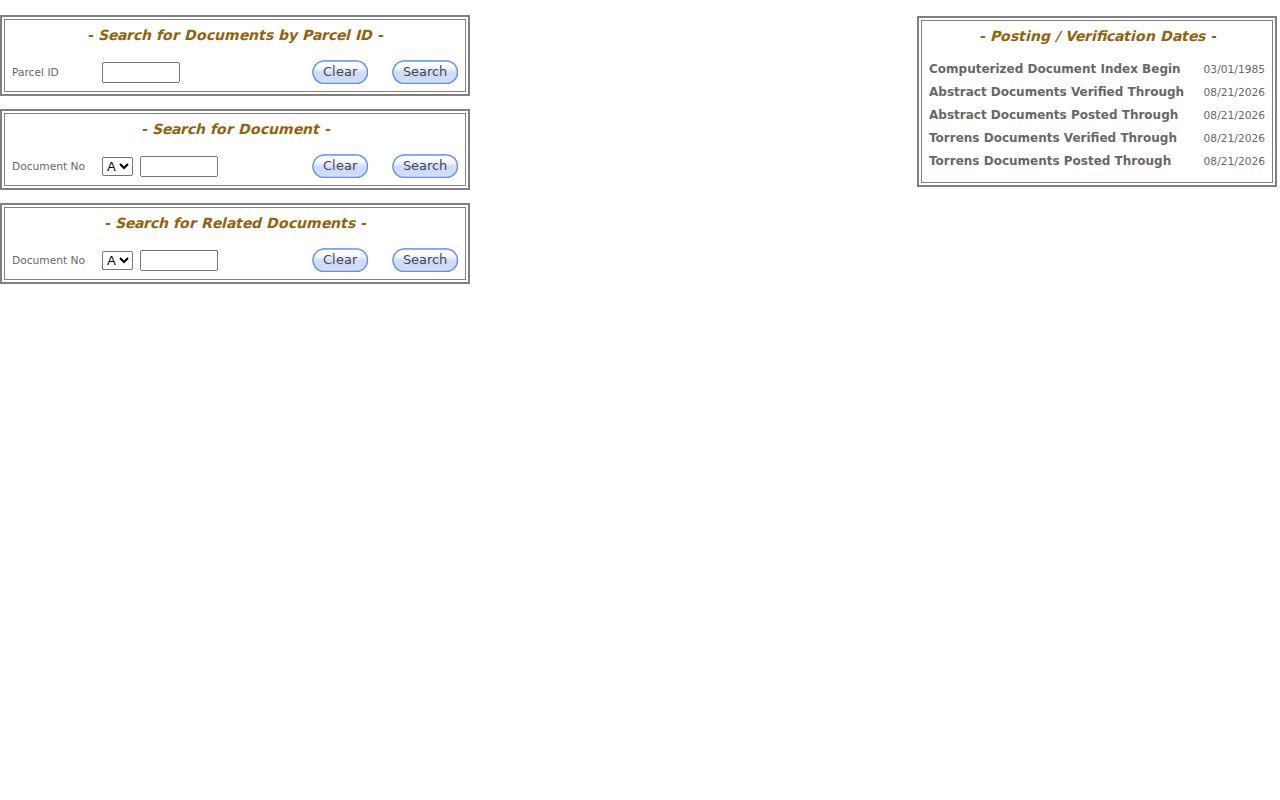
A deed index supplies a transaction trail, not a continuous residents list. Compare it with an appropriate dated directory, voter match, probate file, or archive source.
MCRO Gives Savage Searches a Court-Record Route
Minnesota Court Records Online, or MCRO, serves Scott County District Court and lets users search cases, documents, hearings, and judgments. Case search supports person name, business name, attorney or bar number, and case number or citation. The portal provides a wildcard and a Sounds Like option for name work. Pending criminal matters may require a case number, citation, attorney, or bar search rather than a defendant-name search.
Public remote documents filed on or after July 1, 2015 are available in listed criminal, civil, probate, guardianship, conservatorship, trust, and other categories. A narrower remote range covers listed judgments, orders, opinions, and notices from July 1, 2005 through June 30, 2015. Sealed files and several restricted categories remain unavailable. Scott Court Administration in Shakopee offers public terminals and copy service by email, fax, mail, phone, or in person.
Savage Voter Status Is a Match, Not a Roster
Minnesota’s Voter Status Check is an address-and-identity confirmation tool, not a downloadable Savage residents directory. It requires first name, last name, date of birth, city or township, house number, street, and either ZIP or county. An apartment or unit is required when it belongs to the registration. The service updates nightly, while official registration processing can take up to 14 days.
Minnesota Statutes section 201.091 limits public voter-list use, copying, sale, publication, and online searching. The public list can include name, address, year of birth, voting history, supplied telephone number, and districts, but not full date of birth or identifying numbers. Protected voters and Safe at Home participants have additional safeguards. Use the official status result only to confirm a known person and known address.
Use the official voter-status form rather than treating an address alone as a voter search. The captured form shows the required identity and geography fields.
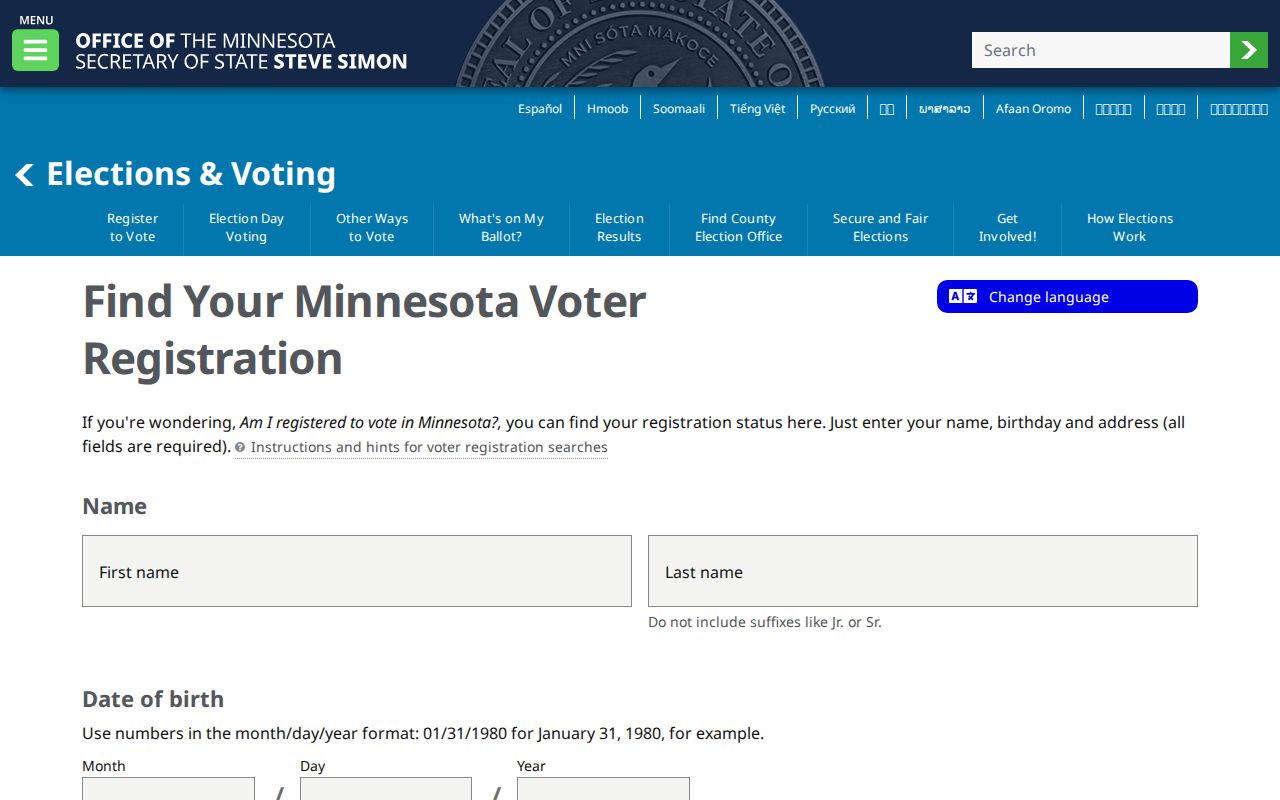
The required fields make the result a person-specific check and preserve the distinction between a status match and a household list.
Minnesota Privacy Boundaries Shape Savage Searches
The Minnesota Government Data Practices Act, Minn. Stat. chapter 13 and especially section 13.03, presumes government data public unless another law classifies it otherwise. Any person may inspect public data, and inspection is free. A custodian need not create a new record or answer a fresh research question, but a denial should cite the legal basis. Scott County’s data-request portal is the fallback for a defined record that is not online.
Other laws still matter. Birth data is confidential before its statutory public period except for eligible requesters. Motor-vehicle personal information is protected under the DPPA. Safe at Home protects a designated address. Court files can be sealed or restricted. The Minnesota Consumer Data Privacy Act gives rights involving covered private businesses, but it does not erase a lawfully public county deed or voter field.
Lawful use. Public records can support family history, estate research, civic questions, and personal verification, but they never authorize stalking, harassment, intimidation, or attempts to expose a protected address.
Requesting a Savage Record When the Portal Stops
A missing online result does not always mean the record is absent. Scott County’s public-data route can be used by any person without stating a reason or providing identification for public data. Identify the record, approximate date, office, address, PID, document number, case number, or other precise clue. The responsible authority can explain classification, retrieval, copy cost, and whether the record exists in a form it can provide.
Savage also has separate city general-public-data and police-public-data routes. The police page accepts online, mail, email, fax, and in-person requests, advises allowing up to 10 days, and applies classification, fee, and authorization rules. Use the library, Historical Society, or MNHS instead when the needed material is a telephone book, newspaper, obituary card, church record, cemetery map, or archive finding aid.
Historical Savage Residents Directory Collections
For past households, the Savage residents directory becomes a shelf-and-microfilm search. MNHS lists Savage telephone-directory holdings beginning with 1936, with additional 1938, 1941 through 1945, 1949, 1953, 1957 and later entries. The inventory also records yellow-pages-only volumes, duplicate print identifiers, and microfiche years. A directory line can anchor a name, phone, and printed address to a particular year, but it does not list every resident.
The Scott County Historical Society adds Savage newspaper microfilm for 1962 through 2014, obituary and announcement cards, church registers, cemetery maps, census material, maps, and plats. The Savage Library Heritage Room holds local newspaper articles and community information. For full collection details and the right volume, use the Savage Directory Book guide.
Hamilton Is an Earlier Name in Savage Resident Research
Historical research needs a second place name. The community was known as Hamilton before it was renamed Savage in 1904 after M. W. Savage. A name-only search for “Savage” can therefore miss older deeds, newspapers, maps, court files, or directory clues filed under Hamilton, Hamilton Landing, Credit River, or Minnesota River language.
When an old record points to the Depot, rail corridor, landing, or an early subdivision, compare the legal description, plat, neighboring parcels, and historical map context before forcing it into a current address string. The documented change in place name is a research aid, not proof that every historical Hamilton reference belongs to one present parcel or person.