
Savage City Directory Shelves at MNHS
The MNHS Scott County telephone-directory finding aid is the confirmed inventory for Savage historical directory work. The countywide collection is dated 1931 onward and holds about 614 volumes and 34 microfiche. Its Savage rows begin in 1936. These are telephone-directory holdings, not a verified pre-1936 Savage-only Polk run. Ask for the precise year and print or fiche identifier rather than assuming that every listed year is one interchangeable book.
| Collection | Years represented | Where held | Access |
|---|---|---|---|
| Savage telephone-directory print holdings | 1936, 1938, 1941–45, 1949, 1953, 1957–64, then later runs through 2005 | MNHS Gale Family Library | Use the finding-aid row and its print identifier |
| General and white-page volumes | Selected 1965–2005 runs | MNHS Gale Family Library | Print holdings, with duplicate identifiers in some years |
| Yellow-pages-only rows | 1960–64 and many later years | MNHS Gale Family Library | Business-subject listings, not a household list |
| Microfiche rows | 1984, 1986, 1988–92, 1999, and 2004 | MNHS Gale Family Library | Fiche identifier in the inventory |
| Savage newspapers and card files | Newspapers 1962–2014; card-file span varies | Scott County Historical Society | Onsite or research-assistance route |
The first two documented Savage years, 1936 and 1938, each have two print holdings. The finding aid also lists multiple print identifiers in later years. Those duplicates may represent separate copies or formats, so a note should retain the exact identifier. A missing year in the row is a collection gap, not proof that a person left Savage.
The telephone-directory finding aid is pictured below. It is the starting point for choosing a real Savage city directory volume instead of guessing from a general date range.
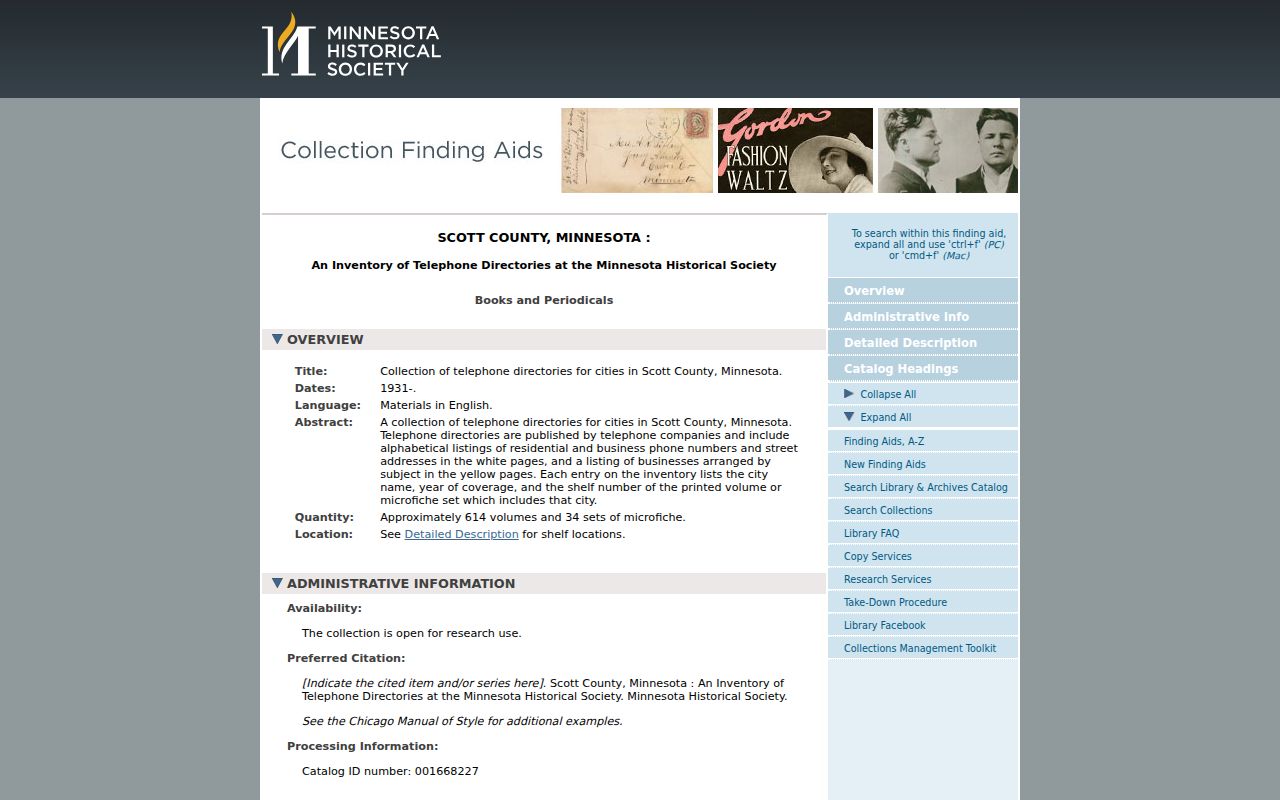
The holdings are broad enough to trace many later twentieth-century address changes, but the volume type still matters. A yellow-pages-only item cannot replace a white-page lookup.
Savage City Directory Year Formats
Not every item in the Savage city directory inventory serves the same purpose. White pages are alphabetical entries that generally show a name, telephone number, and street address. Yellow pages organize business listings by subject. A year can have general and yellow-pages-only entries, and some years appear as microfiche rather than printed books. Write down which format you read before comparing a person from one year to the next.
The research did not locate a complete separate reverse or criss-cross directory run for Savage. A criss-cross directory is arranged by address instead of name. It can be useful when a street number is the starting point, but a local reverse-run year list should not be invented from the telephone-book inventory. When an address must be traced through time, use the printed name entry, deeds, and dated newspapers together.
- White pages
- Alphabetical telephone listings, generally carrying a name, phone number, and street address.
- Yellow pages
- Business listings arranged by subject rather than a residential name list.
- Criss-cross directory
- An address-ordered directory; the MNHS finding aid does not confirm a complete separate Savage run.
- Abbreviation key
- The legend printed in a volume that explains its own shorthand. Copy it with any ambiguous entry.
Reading a Savage City Directory Line
A Savage city directory line should be transcribed, not expanded with assumptions. The confirmed telephone-directory format supports a name, a telephone number, and a street address in white pages. It does not support claims that every Savage entry supplied a spouse, occupation, organizational affiliation, property-status notation, or widow notation. No local entry image was captured from the closed print collection, so those fields remain unverified for this collection.
| Name | Record the spelling exactly as printed, including initials and punctuation. |
|---|---|
| Telephone number | Transcribe the number when the white-page entry supplies one. |
| Street address | Copy the number and street as printed, then compare it with the year of the volume. |
| Volume type | State whether the source is white pages, yellow pages, or another identified format. |
| Volume and page | Keep the exact year, print or fiche identifier, and page for later checking. |
A changed phone number or address is a lead, not proof of a move, death, or family event. Nearby alphabetical entries may reveal a shared surname or phone number, yet that also needs a second source before it becomes a relationship conclusion.
Savage City Directory Search Requests
The MNHS Gale Family Library maintains city directories, telephone books, newspapers, state archives, court finding aids, naturalization material, and microfilm. For a search that cannot be done in person, MNHS offers a paid city-directory and telephone-book request. One order can ask for up to five years, with scans or email results when available. Research says the usual turnaround is three to four weeks and can be as long as 12 weeks.
Give MNHS the full name, spelling variations, city, approximate years, and any known street. The strongest request identifies whether the target is a white-page address entry, a telephone number, or a business-subject listing. An order is not a guarantee that a name appears in every volume. The staff can search the specified materials, while an unlisted number or missing volume remains a real limit.
MNHS research services are shown below. The research-service route is useful when the needed Savage city directory is held at the library rather than online.
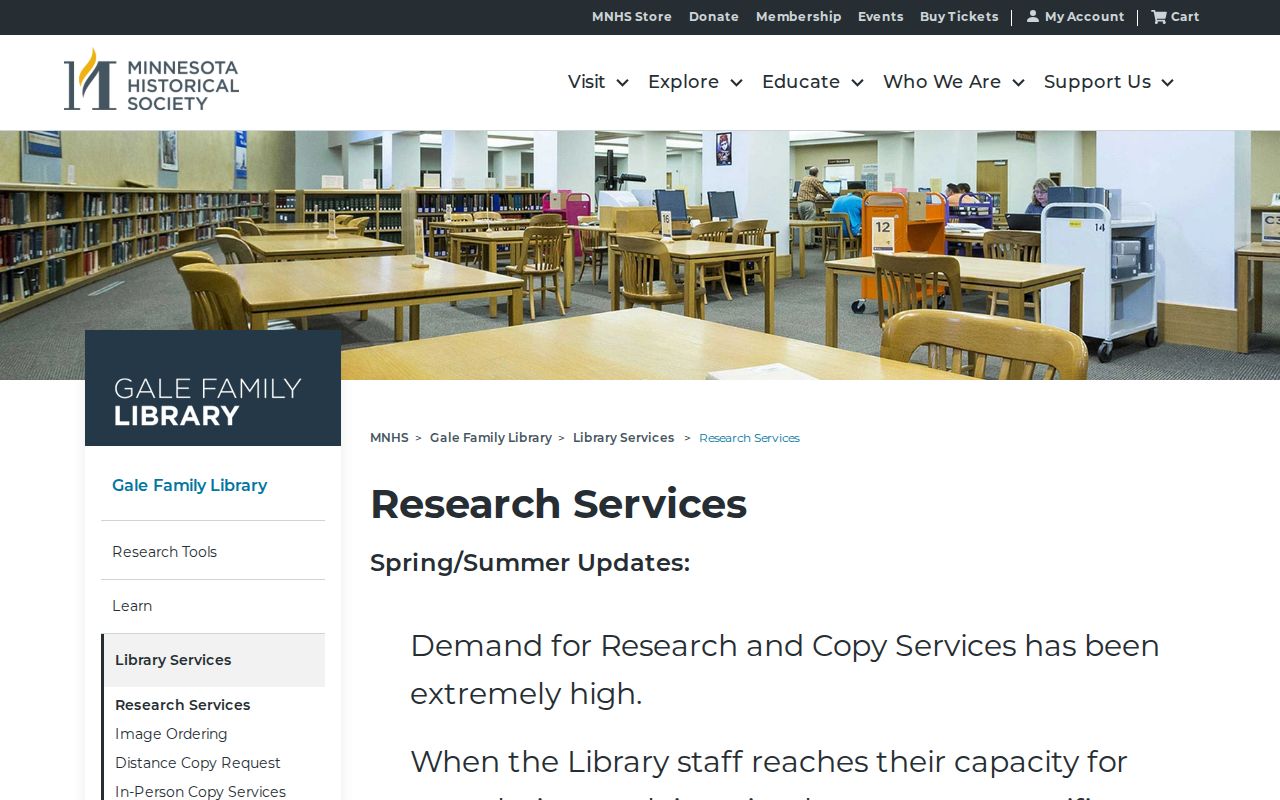
A focused request preserves the distinction between a directory transcription and a broader family-history conclusion.
The MNHS city-directory search request page is also pictured below. It is the order path for a small, specified set of directory or telephone-book years.
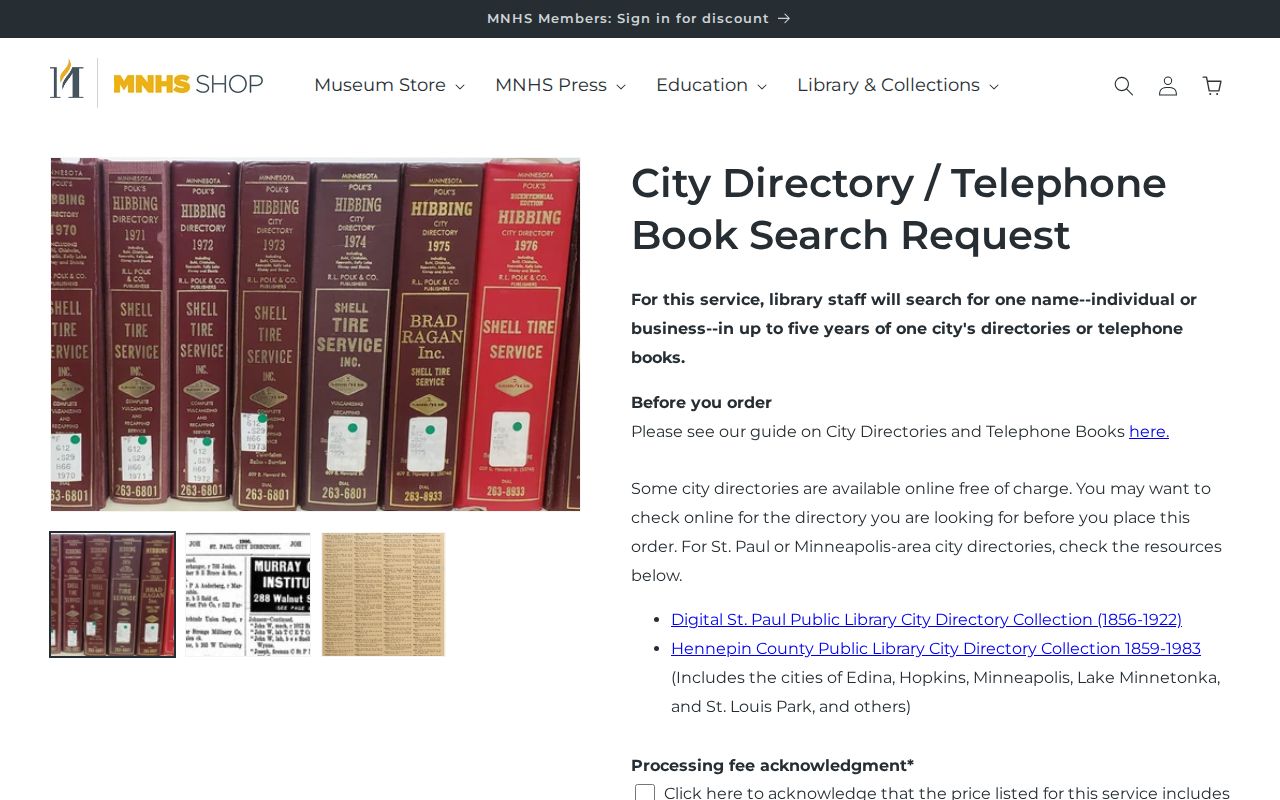
Requesting only the relevant years makes the result easier to compare with a dated obituary, census, deed, or court record.
Savage Directory Companions at SCHS
The Scott County Historical Society supplies the local materials that the telephone books do not. Its research library is at 235 Fuller Street S in Shakopee and is open Tuesday through Friday from 9:00 to 4:00 and Saturday from 10:00 to 3:00. The phone number is 952-445-0378. Holdings include Savage newspaper microfilm for 1962–2014, obituary and announcement cards, church registers, cemetery maps, census holdings, subject files, county plats, and local maps.
Savage Library's Heritage Room at 13090 Alabama Ave S keeps newspaper articles and community material. Bring a surname, date, event, or address to focus a request. The Heritage Room provides Savage-specific orientation, while SCHS adds the countywide newspaper, map, card-file, church, and cemetery holdings.
Those materials can test a directory change. An obituary card may provide a date trail. A church register can identify a record range once the congregation is known. Cemetery maps can place a family group. County maps from 1874, 1880, 1898, 1913, and 1944 help relate a street or subdivision to a different period. Completeness and restrictions vary by collection, so ask for the year, surname, congregation, event, or address rather than a general search for every record.
The Historical Society holdings page appears below. It shows why newspapers, cards, maps, and registers are practical companions to a Savage city directory line.
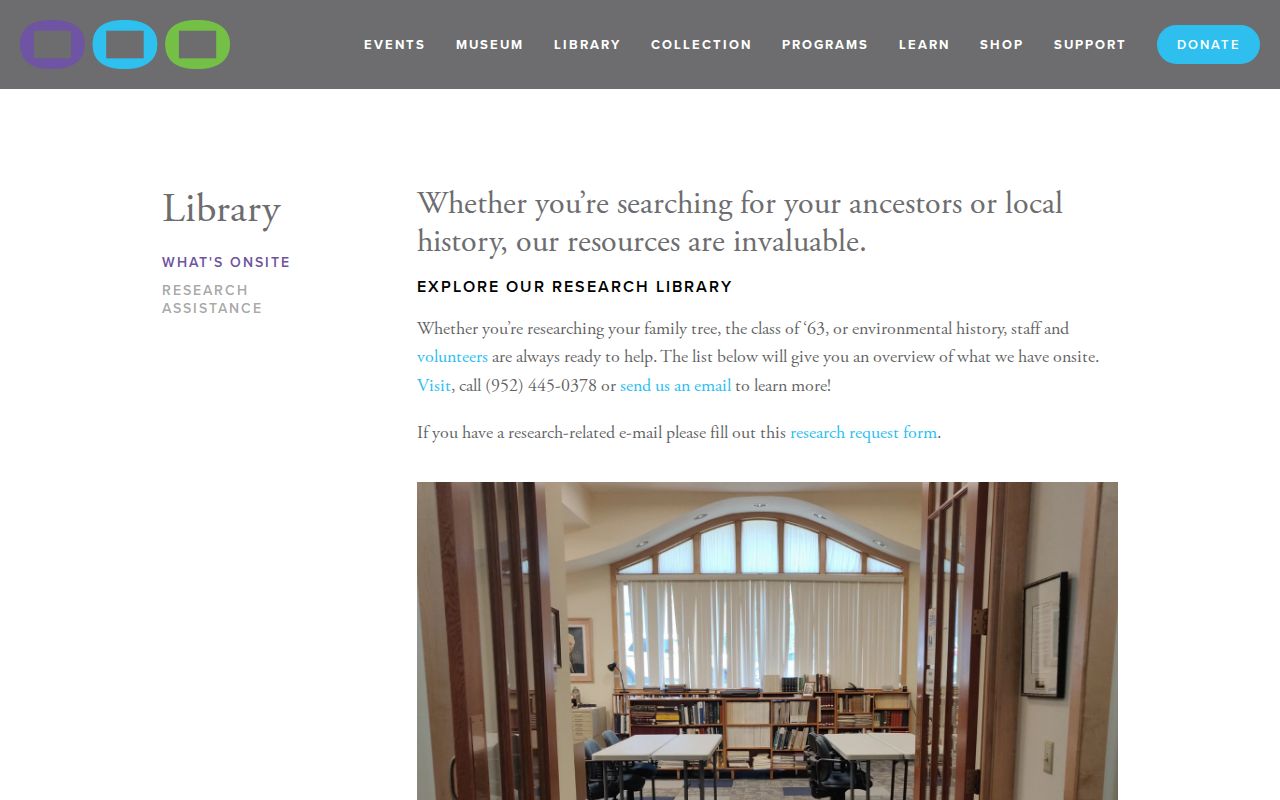
The Historical Society and MNHS have different strengths. One surname can disappear from a directory and reappear in a card file, a newspaper notice, or a county map.
Hamilton Terms in Savage City Directories
Historical searches must allow for a change in place name. The settlement was known as Hamilton before its 1904 renaming to Savage. Try Hamilton, Hamilton Landing, Credit River, Minnesota River, rail, and Depot terms when a pre-1904 name does not appear under Savage. The city was incorporated in 1892, but early material can still use the earlier local name.
This is a records-geography issue, not a shortcut to identity. A current address should be bridged to an old reference through a plat, legal description, deed, or contemporary map. The Savage Depot was built in 1880 and relocated in 2006, so a historical Depot reference should be checked against maps and newspapers rather than matched to a present street label alone.
Trace a Savage City Directory Household
Start with one full name and a reasonable year from a known address, obituary, court file, census, school yearbook, or newspaper. The goal is not to force a continuous narrative from a few printed lines. It is to build a dated sequence and flag each change for confirmation. Federal census access follows the 72-year rule, so directory volumes can help fill the years between released census records.
- Choose a confirmed Savage directory year and record the exact entry, volume type, print or fiche identifier, and page.
- Copy the spelling, street number, street name, and phone number shown in the white-page line.
- Move one directory year backward or forward. Mark a changed address, spelling, or phone number as a lead rather than a conclusion.
- Compare the date with census material, a deed, probate paper, or a newspaper notice. Preserve the source that confirms any relationship or move.
- When the trail stops, ask SCHS about obituary cards, newspapers, church registers, cemetery maps, or subject files for that date range.
A person can disappear from a directory because a number was unlisted, the volume changed format, the name was misspelled, the address changed, or the person left the area. A missing entry alone does not settle which explanation applies.
Note: Keep each Savage city directory year separate from later sources, because a printed address records the date of that volume, not a permanent residence.
Savage Directories and Naturalization Names
For immigrant-family research, the Scott County naturalization finding aid covers declarations from 1853–1929, final papers from 1859–1906, later petitions and record material from 1918–1929, certificate stubs from 1907–1920, and six microfilm reels. The personal-name index covers 1859–1906, but it is incomplete and out of order.
A missing card should therefore lead to the surrounding microfilm volume, not to a claim that no record exists. Pair a possible naturalization name with a city directory or telephone address only after checking the year, spelling, family clues, and location. A later Savage address can guide a family-history search, but it does not prove that a person lived in Savage when the earlier naturalization document was created.
The Scott County naturalization finding aid is shown below. Its incomplete index is a reason to search at the volume level when a card lookup fails.
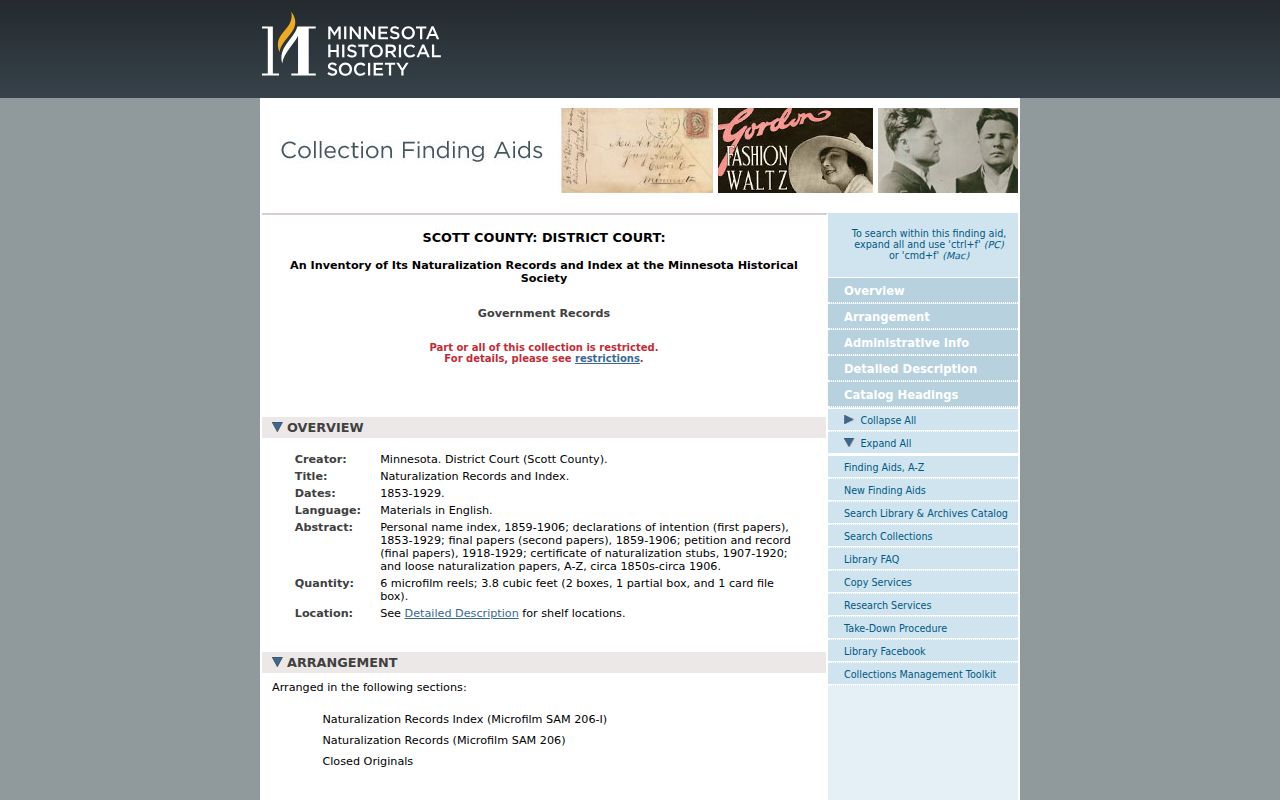
That volume-by-volume check is especially useful when changing spellings make an alphabetical directory search incomplete.
Savage City Directory Court Clues
Early Scott District Court holdings can add dates and party names to a directory trail. The historical court finding aid covers civil and criminal files from 1854–1932, with registers and indexes extending into 1945. It identifies registers of actions, party indexes, filed papers, subpoenaed persons, dates, fees, and judgment references. The finding aid also lists missing file numbers.
A missing file number is a finding-aid fact, not evidence that no matter existed. Use it as a prompt to check surrounding registers, newspaper coverage, or an alternate party spelling. A court name may match a directory name without identifying the same person, so compare dates, place, address, and other independent facts before connecting the two records.
The Scott District Court historical finding aid is pictured below. It provides the archival route when a Savage city directory name needs a dated court-context check.
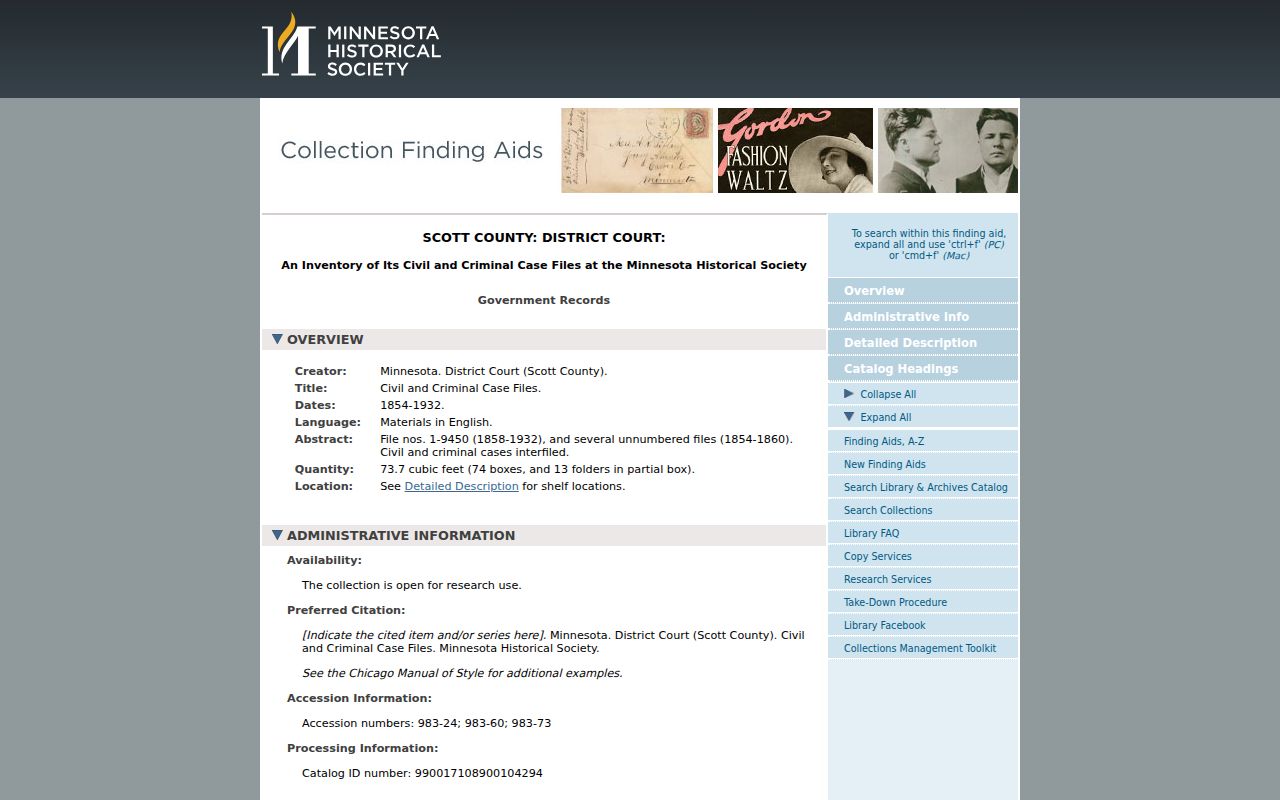
Use the finding aid to locate a record series first, then request or inspect the specific record through the archival access route.
Savage City Directory Limits
Savage city directories are historical snapshots, not current identity records. They can omit unlisted numbers, apartments, people without a telephone listing, and anyone who was not represented in that volume. Yellow pages do not replace white pages. A printed street address does not prove a relationship, a present address, or that a person still lives in Savage.
Use names and addresses only for lawful personal, family-history, or civic research. Minnesota protects Safe at Home participants and restricted voter information, and public material never authorizes stalking, harassment, threats, or publication of a protected location. When a fact matters, verify it with the original archive, county office, or other appropriate custodian.